Trusted company that deals in quality-made products

 08045812644
 Mon-Sat 9.00 AM - 6.00 PM
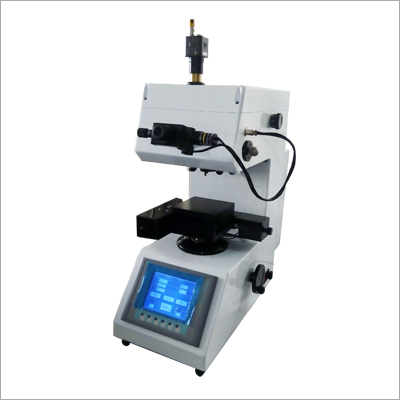
Automatic Microhardness Tester
1000000.00 - 2000000.00 INR/Number
Product Details:
- Voltage 220 - 380 Volt (v)
- Product Type Automatic Microhardness Tester
- Test Range 5-3000 hv
- Material Mild Steel
- Power Supply electric
- Operating Voltage 220 - 380 Volt (V)
- Automation Grade Automatic
- Click to view more
X
Automatic Microhardness Tester Price And Quantity
- 1000000.00 - 2000000.00 INR/Number
- 1 Number
Automatic Microhardness Tester Product Specifications
- Mild Steel
- electric
- 5-3000 hv
- Automatic Microhardness Tester
- 90 Kilograms (kg)
- 220 - 380 Volt (v)
- Metallurgical Analysis
- White
- touch screen
- layer hardness, coating hardness, phase hardness
- 220 - 380 Volt (V)
- Automatic
Automatic Microhardness Tester Trade Information
- Pune
- 3 Number Per Month
- 6 Week
Product Description
Automatic Microhardness Tester with motorized XYZ stage, motorized loading and auto measurement system.
- Load Range - 10 gm to 1 kg; optional 5 gm, 1 gm, 2000 gm
- Auto turret
Specification
|
Dwell Time |
5 - 95 Seconds |
|
Material |
Mild Steel |
|
Net Weight |
90 Kg |
|
Objectives |
10X, 20X, 40X, 60X |
|
Test Load |
10 - 1000 gf |
|
Voltage |
220 - 380 V |
|
Brand |
Conation |
|
Automation Grade |
Automatic |
|
Load Capacity |
2 Kg, 5 Kg,10 Kg, 20 Kg, 30 Kg |
|
Display Type |
LCD Touch Screen |
|
Hardness Scale |
HV, HK, HB |
Optimized for Layer and Coating Hardness Testing
This microhardness tester is engineered to deliver precise measurement across layered structures, coatings, and phases within metals. By automating the indentation process and analysis, it minimizes user effort and improves repeatability, making it ideal for advanced metallurgical research and industrial quality assurance.
Adaptable Power and User-Friendly Design
With an operational voltage range of 220 to 380 Volt (v), the device accommodates varied laboratory power setups in India and abroad. Its ergonomic and clean, white design, facilitates easy integration into laboratory environments, ensuring intuitive operation for both seasoned professionals and newcomers.
FAQ's of Automatic Microhardness Tester:
Q: How does the Automatic Microhardness Tester function for metallurgical analysis?
A: The Automatic Microhardness Tester uses a precision indenter to measure the hardness of layers, coatings, and phases within metallic samples. Its automated system ensures consistent indentation and measurement, which is crucial for accurate metallurgical analysis.Q: What types of hardness measurements can this tester perform?
A: This microhardness tester is capable of assessing layer hardness, coating hardness, and phase hardness, making it suitable for detailed material characterization in research and industrial applications.Q: When is the Automatic Microhardness Tester recommended for use?
A: The tester is best utilized during quality control processes, material development, or whenever detailed hardness profiling of coatings, layers, or phases in metallurgical samples is required.Q: Where can this microhardness tester be installed and operated?
A: This device can be installed in laboratories, research institutions, and industrial facilities across India, provided that there is access to an electric supply within the 220 to 380 Volt (v) range.Q: What process should be followed for using the tester?
A: Users should securely place the prepared sample within the tester, select the appropriate program for layer or coating evaluation, and initiate the automated hardness testing sequence for precise results.Q: How is this tester beneficial compared to manual methods?
A: Automation greatly reduces operator-induced errors, ensures consistent measurements, increases throughput, and enables detailed hardness mapping, providing reliable information for metallurgical research and production quality control.Tell us about your requirement

Price:
Quantity
Select Unit
- 50
- 100
- 200
- 250
- 500
- 1000+
Additional detail
Mobile number
Email

Other Products in 'Microhardness Testers' category


Our Products
Quick Links

- Flat NO. 3, DINKAR SMRITI OFF. J. M. ROAD, CTS 1295 SHIVAJI NAGAR,Pune - 411005, Maharashtra, India
- Phone : 08045812644
GST : 27AAJCC6007F1ZU

- Mr Prashant P (Head-Applications)
- Mobile : 08045812644
-
 Send Inquiry
 Send Inquiry
 Send Inquiry
 Send SMS
 Call Me Free

CONATION TECHNOLOGIES PRIVATE LIMITED
All Rights Reserved.(Terms of Use)
Developed and Managed by Infocom Network Private Limited.
Developed and Managed by Infocom Network Private Limited.


