Trusted company that deals in quality-made products

 08045812644
 Mon-Sat 9.00 AM - 6.00 PM
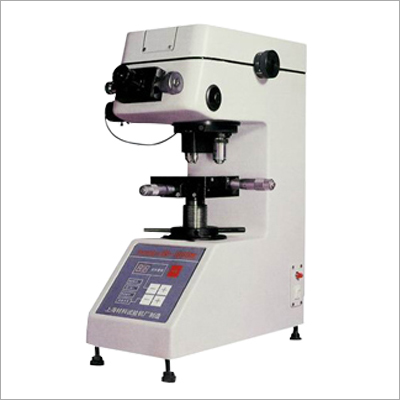
Manual Microhardness Tester
250000.00 - 400000.00 INR/Number
Product Details:
- Usage labooratory
- Color White
- Application Tester
- Power Supply Electric
- Product Type Manual Microhardness Tester
- Power 220-380 Volt (v)
- Click to view more
X
Manual Microhardness Tester Price And Quantity
- 1 Number
- 250000.00 - 400000.00 INR/Number
Manual Microhardness Tester Product Specifications
- labooratory
- Tester
- White
- Manual Microhardness Tester
- 220-380 Volt (v)
- Electric
Manual Microhardness Tester Trade Information
- 3 Number Per Month
- 4 Week
- All India
Product Description
Manual Microhardness Tester
Manual Microhardness Tester is precisely engineered for catering the industrial as well as research work demands as per the International and Indian Standards. This is developed for testing the load from 10, 25, 50, 100 to 1000 Gms in dwell time up to 95 seconds. It is designed with 10X for scanning and 40X for measurement along with motorized loading and releasing features. In addition, this Manual Microhardness Tester is available with manual rotating turret, manual filler micrometer eyepiece (10X) and membrane keyboard panel.
Load Range - 10 gm to 1 kg
Motorized Loading
Manual Load selection by rotating knob
Feather key panel
Precision Hardness Testing for Laboratories
This manual microhardness tester is engineered for accuracy and reliability, making it an essential instrument in any laboratory. Utilized by professionals for testing the hardness of metals, ceramics, and composite materials, this tool delivers reproducible and precise results, supporting detailed material research and quality assurance processes.
User-Friendly Electric Operation
Designed for hassle-free use, the tester operates on a standard 220-380 Volt electric supply commonly available in laboratory environments across India. Its manual operation allows for controlled, step-by-step testing, ensuring clear and dependable results every time.
FAQ's of Manual Microhardness Tester:
Q: How is the Manual Microhardness Tester operated in the laboratory?
A: The tester is operated manually, allowing users to apply precise loads on the test sample. It requires an electric power supply of 220-380 Volts and features intuitive controls designed for laboratory use, which enable smooth and accurate hardness measurement.Q: What types of materials can be tested with this microhardness tester?
A: This microhardness tester is suitable for testing a variety of materials including metals, ceramics, alloys, and other solid samples commonly found in research and industrial laboratories.Q: When should the microhardness tester be used during material analysis?
A: The tester should be used whenever precise hardness values are required, typically after sample preparation and before or during quality verification procedures in laboratories to ensure reliability and compliance.Q: Where is this microhardness tester manufactured and supplied?
A: This tester is manufactured and supplied in India, ensuring proximity for local laboratories and institutions, as well as adherence to regional standards and support.Q: What is the process for performing a hardness test with this device?
A: To perform a test, prepare the sample and place it under the indenter. Set the required load manually, activate the unit with electric power, and follow the measurement steps as per the user manual. Read and record the hardness values displayed after indentation.Q: How is this microhardness tester beneficial for laboratory applications?
A: It offers accurate and reproducible hardness measurements essential for research and quality control. Its reliable electric operation, precise manual controls, and durable construction enhance laboratory efficiency and data credibility.Tell us about your requirement

Price:
Quantity
Select Unit
- 50
- 100
- 200
- 250
- 500
- 1000+
Additional detail
Mobile number
Email



Our Products
Quick Links

- Flat NO. 3, DINKAR SMRITI OFF. J. M. ROAD, CTS 1295 SHIVAJI NAGAR,Pune - 411005, Maharashtra, India
- Phone : 08045812644
GST : 27AAJCC6007F1ZU

- Mr Prashant P (Head-Applications)
- Mobile : 08045812644
-
 Send Inquiry
 Send Inquiry
 Send Inquiry
 Send SMS

CONATION TECHNOLOGIES PRIVATE LIMITED
All Rights Reserved.(Terms of Use)
Developed and Managed by Infocom Network Private Limited.
Developed and Managed by Infocom Network Private Limited.


