Trusted company that deals in quality-made products

 08045812644
 Mon-Sat 9.00 AM - 6.00 PM
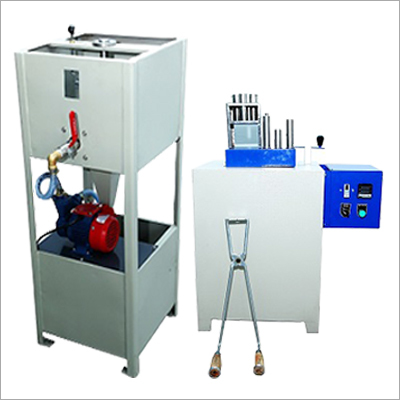
Jominy End Quench Test Set-up
60000.00 - 200000.00 INR/Number
Product Details:
- Accuracy As per ASTM A255 standard
- Test Range Hardenability range as per ASTM A255
- Measuring Range Up to full specimen length
- Response Time Immediate, post-quenching
- Hardness Dependent on steel; measured post-test
- Number of Specimens 1 per test
- Color White
- Click to view more
X
Jominy End Quench Test Set-up Price And Quantity
- 1 Number, ,
- 60000.00 - 200000.00 INR/Number
Jominy End Quench Test Set-up Product Specifications
- Jominy End Quench Test Set-up
- Manual
- Manual
- White
- 1 per test
- 25 mm diameter x 100 mm length
- Bench Top
- Manual
- Dependent on steel; measured post-test
- Immediate, post-quenching
- Up to full specimen length
- Approx. 50 kg
- As per ASTM A255 standard
- Hardenability range as per ASTM A255
- Standard specimen size (25 mm diameter)
- Water jet nozzle: standard (12.5 mm)
- Standard AC supply
- Approx. 800 mm (assembled unit)
- Water Reservoir, Specimen Holder, Quick Jet Release Mechanism, Drain Valve
- 1 Specimen/Test
- Manual (Water Jet initiated by lever)
- 220 V
- Room Temperature (Ambient or as specified by test)
- 220 Volt (v)
- laboratory
- Determining hardenability of steels
- Electric
- Jominy End Quench Test Set-up
- Not Applicable (physical measurement)
- Dependent on measuring device (typically 0.1 mm for indentation spacing)
- Stainless Steel
- Standardized as per ASTM A255 (approx. 5 liters/min)
- Specimen Holder, Water Jet Nozzle, Water Reservoir, Connecting Tube
- Mild Steel, Powder Coated Finish
- ASTM A255, IS 3848
- Powder Coated
- 10 liters
- Approx. 5 liters per test
- End-quench (Jominy) method
Jominy End Quench Test Set-up Trade Information
- Pune
- 5 Number, , Per Month
- 2 Week
Product Description
Jominy End Quench Test Set-up
measures Hard enability of steel. Hard enability is a measure of the capacity of a steel to be hardened in depth when quenched from its austenitizing temperature.set-up consist of specially design edvertical muffle furnace,Jominy Quenching fixtureand allied accessories. Jominy Fixture also can be designed in SS.Designed as per SAE J406/IS 3848
Specification
|
Application |
For test the Hardenablility |
|
Continuous Operating Temprature |
1050 Degree C |
|
Electrical Rating |
3 kW,220V Single Phase |
|
Heating Chamber |
150x150x300 mm |
|
Heating Element |
Kanthal A1 |
|
Max Temprature |
1200 Degree C |
|
Thermocouple |
Chromel/Alumel |
|
Brand |
Conation |
Precise Hardenability Testing for Steel
Designed for laboratory environments, the Jominy End Quench Test Set-up streamlines hardenability assessment, adhering strictly to ASTM A255 and IS 3848 standards. Its robust, powder-coated mild steel construction ensures durability while the stainless steel specimen holder secures samples reliably. The included accessories, like the water jet nozzle and reservoir, support consistent and repeatable test results, making it ideal for metallurgical research and quality assurance.
Efficient Water Management and Operation
With a standardized water flow rate of 5 liters per minute and a 10-liter reservoir, this apparatus minimizes water wastage and allows for consecutive tests with minimal downtime. Manual jet release and lever-initiated quenching enable precise operator control over the quench process, ensuring accurate results and compliance with international testing standards.
User-Friendly and Reliable Design
This bench-top unit is straightforward to set up and use. Key features like the quick jet release mechanism, easy-to-mount structure, and drain valve make operation and maintenance simple. The equipment supports immediate, physical measurements following the quench, aiding fast turnaround in laboratory workflows without the need for complex electronic displays.
FAQ's of Jominy End Quench Test Set-up:
Q: How does the Jominy End Quench Test Set-up determine the hardenability of steel?
A: This setup uses the end-quench (Jominy) method, where a heated standard steel specimen is quenched at one end with a jet of water. The hardness profile is then measured along the specimen's length, reflecting the steel's hardenability as per ASTM A255 guidelines.Q: What are the main components included with the test apparatus?
A: Each setup comes with a stainless steel specimen holder, a water jet nozzle, a 10-liter water reservoir, connecting tube, and drain valve to ensure smooth operation and setup.Q: When should this equipment be used in a laboratory setting?
A: The Jominy End Quench Test Set-up should be used when determining and comparing the hardenability of steels, either in research or quality assurance stages of steel processing. It is best utilized at ambient room temperature, immediately after the specimen is heated to its specified test temperature.Q: Where can the Jominy End Quench Test Set-up be installed?
A: This unit is designed for bench-top mounting, making it suitable for metallurgical labs, educational institutions, and quality control departments, especially where precise hardenability data is required.Q: What is the step-by-step process of conducting a test with this apparatus?
A: First, heat the steel specimen to the required temperature, mount it in the specimen holder, and align it under the water jet nozzle. Once the specimen is ready, initiate the water jet quench using the manual lever. After quenching, measure hardness at specified intervals along the specimen length.Q: How much water does the system consume per test?
A: The system is designed to use about 5 liters of water per test, with a quenching water flow rate of approximately 5 liters per minute, ensuring sufficient cooling as per ASTM standards.Q: What are the benefits of using this manual test setup?
A: It offers standardized, reproducible hardenability testing with accurate control over quenching conditions. The robust and easy-to-use design, quick jet release, and manual operation make it reliable for frequent laboratory testing, ensuring compliance with international standards.Tell us about your requirement

Price:
Quantity
Select Unit
- 50
- 100
- 200
- 250
- 500
- 1000+
Additional detail
Mobile number
Email



Our Products
Quick Links

- Flat NO. 3, DINKAR SMRITI OFF. J. M. ROAD, CTS 1295 SHIVAJI NAGAR,Pune - 411005, Maharashtra, India
- Phone : 08045812644
GST : 27AAJCC6007F1ZU

- Mr Prashant P (Head-Applications)
- Mobile : 08045812644
-
 Send Inquiry
 Send Inquiry
 Send Inquiry
 Send SMS

CONATION TECHNOLOGIES PRIVATE LIMITED
All Rights Reserved.(Terms of Use)
Developed and Managed by Infocom Network Private Limited.
Developed and Managed by Infocom Network Private Limited.
